OFFER

Oxygenating Foundation
Developed for use immediately after procedures, it combines breathable coverage with skin-healing support,.
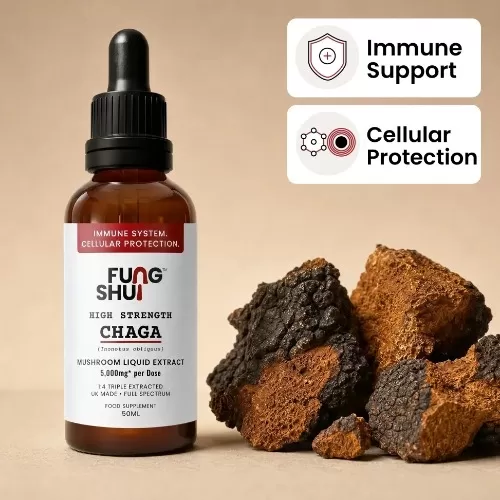
If you're looking to support your immune system and general resilience as you move through midlife, Chaga mushroom is one of the more distinctive names in the functional mushroom category. This liquid tincture is a single-ingredient supplement made from Chaga fruiting body, positioned by the manufacturer around immune support, cell protection and metabolism. Chaga has a long tradition of use and a genuinely interesting laboratory research base, but it also comes with one specific safety consideration, relating to kidney health, that's worth understanding clearly before you add it to a daily routine.
This liquid tincture is made from the Chaga (Inonotus obliquus) fruiting body, extracted in water and alcohol. It's a single-mushroom product containing Chaga extract plus supporting botanicals and vitamins: acerola cherry (a source of vitamin C), guava leaf (a source of zinc), plus added vitamin B6 and chromium.
Chaga is a distinctive-looking fungus that grows mainly on birch trees in cold climates, and it has a long history of traditional use in Russia, Siberia, Northern Europe and parts of Asia, historically for general health and digestive complaints. Modern marketing often describes it as having very high antioxidant activity, and this is genuinely one of the better-supported claims in laboratory research, though strong antioxidant activity in a test tube doesn't automatically translate into an equivalent effect once something is digested and absorbed.
This product sits in the "functional mushroom" supplement category. It is not a licensed medicine, and the manufacturer clearly states on its own site that its tinctures are not intended to diagnose, treat, cure, or prevent any disease. It's positioned around general immune and metabolic wellbeing rather than as a menopause-specific formula, and this listing makes no menopause-related claims.
It may be less suitable if you have a history of kidney stones, chronic kidney disease, or are otherwise advised to limit oxalate intake, since Chaga is naturally high in oxalates and this is a genuine, published safety consideration covered in more detail below.
Users generally describe chaga as having a mild, earthy taste that blends easily into hot or cold drinks, and manufacturer-reported survey data suggests most customers find it easy to work into a daily routine.
The manufacturer suggests some people notice effects within days, while others may need several months, and recommends at least three months of consistent use before judging whether it's working for you. Because independent human trials on Chaga are limited to small, short studies (the most-cited immune trial ran for 8 weeks), there isn't a well-established, evidence-based timeframe we can point you to for this ingredient, and it's genuinely difficult to predict how a subjective sense of "immune support" or "cell protection" might show up day to day, since these are processes you're unlikely to notice directly.
Chaga isn't an established treatment for any specific menopause symptom and shouldn't replace medical care, particularly for anything related to immune function or kidney health, where ongoing monitoring by a healthcare professional matters more than a supplement.
Each 50ml bottle contains water, alcohol, and 100% Chaga mushroom fruiting body (125,000mg per 50ml bottle, at a stated 1:4 ratio), plus acerola cherry extract (vitamin C), guava leaf extract (zinc), and added vitamin B6 and chromium. The manufacturer states there are no added fillers, flavourings or preservatives, and that the product is plant-based, gluten-free and free from dairy and added sugar.
Chaga (Inonotus obliquus) Chaga has attracted considerable laboratory interest for its antioxidant, anti-inflammatory and immune-modulating compounds, including melanin complexes, polyphenols and triterpenoids. Some of this research is genuinely striking, with Chaga showing higher antioxidant activity than several other well-studied medicinal mushrooms in laboratory testing. Human clinical evidence is much more limited. One small study of 36 people over 8 weeks found increased natural killer cell activity and favourable changes in certain immune markers, which is an encouraging early signal, but this is a single small trial rather than a robust evidence base, and researchers reviewing the wider literature consistently note that larger human trials are still needed before firm conclusions can be drawn about immune, metabolic or cellular-protection benefits in people. We found no published trial testing this specific tincture, dose or format.
Safety considerations, including an important kidney-related risk Chaga is generally well tolerated at typical supplement doses, but it carries one safety consideration that's more specific and more serious than is often acknowledged in general marketing:
There's no established UK clinical guidance suggesting Chaga is unsafe to combine with HRT specifically, as it doesn't contain hormone analogues, but this combination hasn't been formally studied. Given the kidney-related risk above, we'd encourage anyone with a history of kidney issues, or who takes regular prescription medication, to check with a pharmacist, GP, or (for kidney concerns specifically) a nephrologist before starting.
The product page states the tincture is third-party tested for heavy metals, microbiological safety and beneficial compounds, though no certificate of analysis is published on the page itself for independent review.
The manufacturing approach here has some genuine strengths: fruiting-body-only extraction rather than cheaper mycelium-on-grain, a stated 1:4 extraction ratio, and no fillers or preservatives. As a single-ingredient product, it's also transparent about what you're taking, which matters given the safety point below.
We'd encourage a more measured view of both the marketing language and, specifically for Chaga, the safety framing. Claims such as "science backed," "300+ scientific papers," and a specific "7 times more bioavailable" figure attributed to a University of Queensland study are manufacturer claims we haven't been able to independently verify in the form stated; the actual UQ research we found relates to an isolated compound from Lion's Mane and nerve growth in laboratory studies, not a Chaga-specific bioavailability comparison. More significantly, the product page's "side effect free" framing (found in the manufacturer's general FAQ) doesn't reflect the published medical literature on Chaga specifically, which includes documented case reports of kidney injury linked to high or prolonged intake. This is a genuine, if likely uncommon, risk that we think anyone considering Chaga should know about clearly, rather than encountering only in fine print or not at all.
We think this is a reasonably well-made single-ingredient product with an interesting laboratory evidence base, but one where the kidney-related safety point deserves more prominence than typical marketing gives it. It may suit you if you don't have any history of kidney issues and aren't on medication that could interact with it, but if any of the safety considerations above apply, please check with a healthcare professional first.
Is this specifically formulated for menopause? No. This is a single-ingredient Chaga tincture marketed around immune support, cell protection and metabolism, without a specific menopause claim on this listing.
Can I take this alongside HRT? There's no established UK clinical guidance against combining Chaga with HRT, since it doesn't contain hormone analogues. This specific combination hasn't been formally studied, and Chaga carries its own safety considerations (see below), so it's worth checking with your GP, pharmacist or menopause specialist if you're also taking other medication.
Is Chaga safe for my kidneys? This is the most important safety question to ask before trying Chaga. It's naturally high in oxalate compounds, and there are published medical case reports of kidney damage (oxalate nephropathy) linked to high-dose or prolonged Chaga use, most commonly with raw powder taken in large daily amounts over weeks or months. If you have any history of kidney stones, kidney disease, or have been advised to limit oxalate in your diet, avoid Chaga or speak to a healthcare professional, ideally a nephrologist, before using it.
Could this interact with any other medications? Yes. Chaga may increase bleeding risk if combined with anticoagulant or antiplatelet medication, may have an additive effect if you take diabetes medication, and its immune-stimulating activity is relevant if you take immunosuppressant medication. Check with a pharmacist or GP if any of these apply to you.
What's actually in the bottle? Water, alcohol and Chaga mushroom fruiting body extract (125,000mg per 50ml bottle), plus acerola cherry extract (vitamin C), guava leaf extract (zinc), vitamin B6 and chromium. No fillers, flavourings or preservatives are stated.
How soon might I notice a difference? The manufacturer suggests some people notice changes within days, though it advises at least three months of consistent use to properly assess the effects. The strongest human evidence we found used an 8-week study period, and immune or cellular-protection effects generally aren't something you'd feel directly, so it's reasonable to treat any timeframe here as an estimate rather than an evidence-backed figure.
Does the "3rd party tested" claim mean this has passed independent safety checks? The manufacturer states the tincture undergoes testing for heavy metals, microbiological safety and compound content via a laboratory. However, no certificate of analysis is published on the product page for independent verification, so this claim currently rests on the manufacturer's own statement. Third-party testing for heavy metals and microbiological safety also wouldn't necessarily flag the oxalate-related kidney risk described above, since that's a property of the mushroom itself rather than a contamination issue.
How does Chaga compare with other mushrooms in FungShui's range, like Lion's Mane or Reishi? Chaga stands out for its laboratory-supported antioxidant profile and its specific kidney-related safety consideration, which Lion's Mane and Reishi don't share in the same way. If kidney health is a concern for you, Lion's Mane may be a more straightforward option to discuss with a healthcare professional, though it carries its own separate safety points worth checking first.
Join The Menopause Network Review Panel to trial products like this one and share your honest experience with other members.
Apply to join the panel
Developed for use immediately after procedures, it combines breathable coverage with skin-healing support,.

A clear look at SuperBotanic's Ashwagandha KSM-66 and Affron saffron capsules: what's inside, the evidence for mood and sleep, and who should check with a doctor first.

Made with 100% natural, rigorously tested ingredients including Yerba Mate, Euglena, Reducose, and Mulberry Leaf Extract.

When skin needs extra coverage, Oxygenating Concealer steps in. Built on the same breathable technology as the foundation, it delivers concentrated pigment that hides imperfections without smothering the skin or clogging pores.